Wash Care
Keep your multiple-use medical textile product performing perfectly. Follow our validated wash care and sterilization cycle for up to 50 safe reuses.
Sustainability & ESG Impact
Discover how each reusable medical textile product helps save 125 kg CO₂ and ₹1,500-₹8,500—while earning ESG Green Points for your institution.
Reusable Autoclavable Medical Textiles – Wash care Instructions
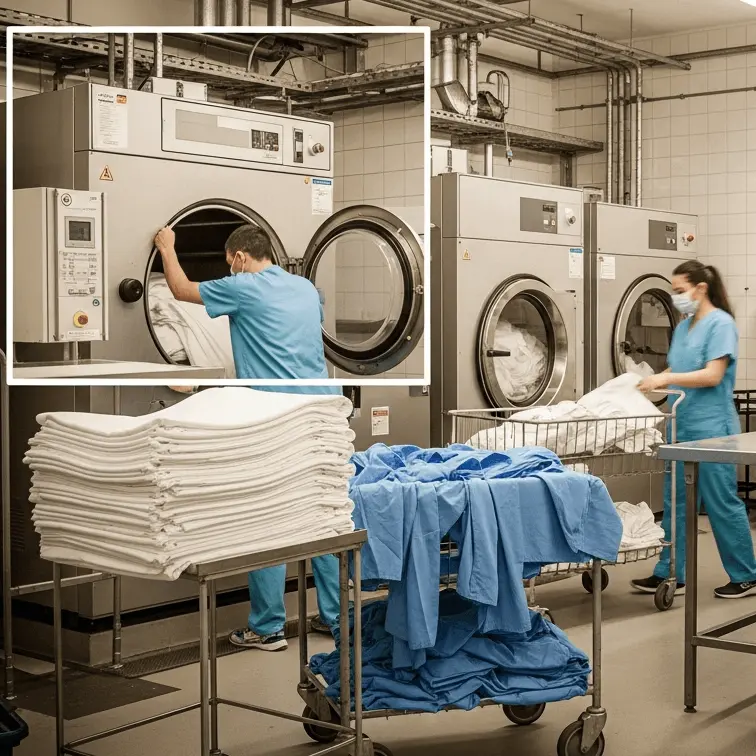
Validated Wash care & Autoclave Instructions
Every reusable healthcare textile including Surgical Gown, Surgical Drape, Scrubsuit & Patient Apparel goes through numerous cleaning and sterilization cycles during its life. Following validated wash care and autoclave guidelines ensures infection control, fabric longevity, and compliance with ISO 13485 and MDR 2017 standards.
These instructions are based on validated protocols designed for Accoutrer® Multiple-Use Medical Wear to maintain performance, color, and barrier protection.
Recommended process flow
(click the links for each process for details)
Pre-wash (segregation) Handling
- Segregate soiled textiles at the point of use into designated color-coded bags.
- Handle with gloves to avoid contamination.
- Do not soak or pre-wash manually—this increases cross-contamination risk.
- Ensure garments are packed in specially designed reusable wash pouches to protect logos, closures, and fabric integrity.
Washing Process Parameters (Validated Conditions)
- Use hospital-grade neutral detergents (pH 6.5–8.5) compatible with medical textiles.
-
Recommended water temperature:
- 60–70°C for routine washing
- 75–80°C for critical garments (OT linen, gowns, drapes)
- Use mechanical agitation within validated limits to prevent damage.
- Avoid chlorine bleach or optical brighteners—these degrade barrier coatings and fabric color.
- Add disinfectant boosters only as validated by your infection control committee.
Rinsing & Neutralization
- Perform at least two rinse cycles with softened or demineralized water.
- Use a mild neutralizer to bring fabric pH between 6.0–7.0 after rinse.
- Proper neutralization prevents skin irritation and ensures effective autoclave penetration later.
Drying & Finishing
- Use tumble dryers or tunnel finishers with exhaust filtration systems.
- Maximum drying temperature: 85°C.
- Avoid direct ironing on logos or reflective labels — use a pressing cloth.
- Do not sun-dry, as UV exposure can weaken fabric coatings.
Ironing
- Use a low to medium heat setting (≤120°C) suitable for medical textiles.
- Never iron directly over logos or reflective prints — cover with a clean cotton cloth.
- Avoid steam bursts; light steam only for wrinkle removal.
- Do not press zippers, Velcro, or reinforced seams directly.
- Ensure the gown is completely dry before folding or packaging.
Inspection & Packaging Prior to Autoclaving
- Place the cleaned, dry gown into its numbered reusable pouch (same serial number as gown).
- Inspect gown and pouch for tears, loose threads, or soiling before sealing.
- Fold neatly to allow uniform steam penetration during sterilization.
- Seal pouch properly and mark wash date, autoclave date, load no., and validity in the table.
- Use only validated pouches to ensure sterility and traceability.
Autoclaving
- Sterilize at 121°C ±2°C for 15–20 minutes at 15 psi pressure.
- Do not overload the autoclave; ensure free steam circulation.
- Use chemical or biological indicators for every load as per SOP.
- Allow a complete drying phase post-cycle to prevent moisture retention.
- Validate cycle parameters periodically for consistent results.
Post-Autoclave Handling
- Let the pouch cool to room temperature before touching or moving.
- Store sterilized gowns in a clean, dry, dust-free area.
- Inspect gown for fabric wear or seam damage after each use.
- Record autoclave cycle count to track the 50-cycle lifespan.
- Discard responsibly when visibly worn or after max cycle limit.
Reusable Autoclavable Medical Textiles – ESG Impact


ESG Impact & Sustainability Calculations
Each Accoutrer® Multiple-Use Medical Textile is more than a garment — it’s a conscious choice to reduce hospital waste, cut CO₂ emissions, and optimize healthcare costs. By replacing single-use disposable gowns with validated reusable ones, healthcare facilities actively contribute to India’s ESG goals, SDG 12 (Responsible Consumption), and the Net-Zero 2070 Vision.
Each reprocessing cycle saves measurable carbon, water, and financial resources, demonstrating that sustainability and safety can coexist without compromise. Every gown reprocessed is a step toward a cleaner, greener, and more cost-efficient healthcare system — proof that small daily actions can drive large environmental change.
Sustainability Calculations
(click the links for each process for details)
Carbon Footprint Reduction (CO₂ Emission Savings)
- One single-use medical gown generates ~2.5 kg CO₂-eq (fabrication, transport, incineration).
- A validated Accoutrer® medical gown used for 50 cycles emits only ~0.25 kg CO₂-eq per use.
- That’s a net saving of ~125 kg CO₂ over its validated life.
-
Equivalent to:
- Driving a petrol car for 550 km, or
- Running a 100 W bulb continuously for 1,500 hours.
- All calculations are based on LCI data from European and Indian medical-textile benchmarks (ISO 14040/44 methodology).
Green Points Accumulation
- Every validated reusable surgical gown earns approximately 2.5 Green Points per cycle, certified under our internal GreenCare framework aligned with MoEFCC (Ministry of Environment, Forest and Climate Change, Government of India) sustainability reporting.
- 1 Green Point = 2.5 kg CO₂ avoided, 1 litre water saved, and ₹170 saved in total resource cost.
- After 50 uses → ~125 Green Points, reflecting a measurable ESG contribution.
- Institutions can track points through QR-based dashboard linked to batch/serial number.
- Green Points can support ESG disclosures, CSR reporting, and carbon-credit readiness.
Cost-Saving Impact
- One disposable surgical gown typically costs ₹180–₹220 per use.
- One Accoutrer® reusable surgical gown (₹1,300–₹1,600) lasts 50 cycles, averaging ₹45–₹60 per use including reprocessing cost.
- Net saving: ₹8,000–₹8,500 per gown lifetime.
- For a 100-bed facility using 2 gowns/day/OT → annual saving > ₹16 lakh.
- Additional savings from reduced biomedical waste management and procurement logistics.
Resource Conservation & Waste Reduction
- Each reusable gown prevents ~220 gm. of non-woven waste per use.
- Over 50 cycles → 11 kg solid waste diverted from incineration/landfill.
- Water savings of ~250 litres compared to single-use lifecycle.
- Reduced packaging & transport emissions (single shipment vs. 50 disposables).
- Compliance with CPCB Biomedical Waste Rules (2016 – Amended 2023) promoting material circularity.
ESG Compliance & Reporting Support
- Quantified data aligns with BRSR (Business Responsibility & Sustainability Report) indicators E1–E3.
- Batch-level traceability enables digital reporting for Scope 3 emission reduction.
- QR-linked verification allows third-party auditors to validate CO₂ and cost data.
- Supports hospital accreditation programs (e.g., NABH, NABL, ISO 14001).
- Demonstrates leadership under “Responsible Procurement” for healthcare institutions.